DART & Luas Dublin 2026: The Complete Rail & Tram Guide
Ar an gComhartha Seo — On this sign
- Quick Picks: When to Use DART vs Luas
- The Luas Tram System
- The DART (Dublin Area Rapid Transit)
- Paying for Luas and DART
- Best DART Day Trips for Tourists
- Best Luas Stops for Tourists
- How to Ride the Luas
- How to Ride the DART
- Common Luas and DART Mistakes
- Combining Luas, DART and Dublin Bus
- MetroLink: The Future of Dublin Rail
- Accessibility on Luas and DART
- Related Reading
- Why DART is Dublin’s Most Scenic Transit Ride
- When the Luas Beats the Bus (and Vice Versa)
- DART, Luas and Match Days
- DART & Luas Dublin: FAQ
- Keep Reading
If you’re visiting Dublin in 2026, you’ll meet two excellent rail systems: DART Dublin (the Dublin Area Rapid Transit coastal commuter line) and the Luas tram (two light-rail lines crossing the city). They’re fast, frequent, scenic and largely traffic-immune — the local commuters’ default and the smartest tourist choice for many journeys. Here’s both systems in detail: routes, fares, how to ride, where they go, when to use them, and the common mistakes that catch first-time tourists.
By the end of this guide you’ll know which line takes you along the coast to Howth, which Luas runs to the Guinness Storehouse, and how to combine DART and Luas with Dublin Bus for the most efficient sightseeing day.
The Dublin transport guide pulls all of this together if you want the overview first.
Quick Picks: When to Use DART vs Luas
- Going to Howth or Bray: DART (generally faster than the bus, with trains about every 10 minutes)
- Trinity to Stephen’s Green to Heuston Station: Luas Green Line then Red Line
- Connolly to Smithfield to Guinness Storehouse: Luas Red Line
- Stephen’s Green to Sandyford (south Dublin): Luas Green Line
- City centre to Dun Laoghaire or coast south of city: DART
- City centre to Kilmainham Gaol: Luas Red Line to Suir Road + a short walk
- Day trip to Greystones: DART direct to Greystones, the southern end of the line

The Luas Tram System
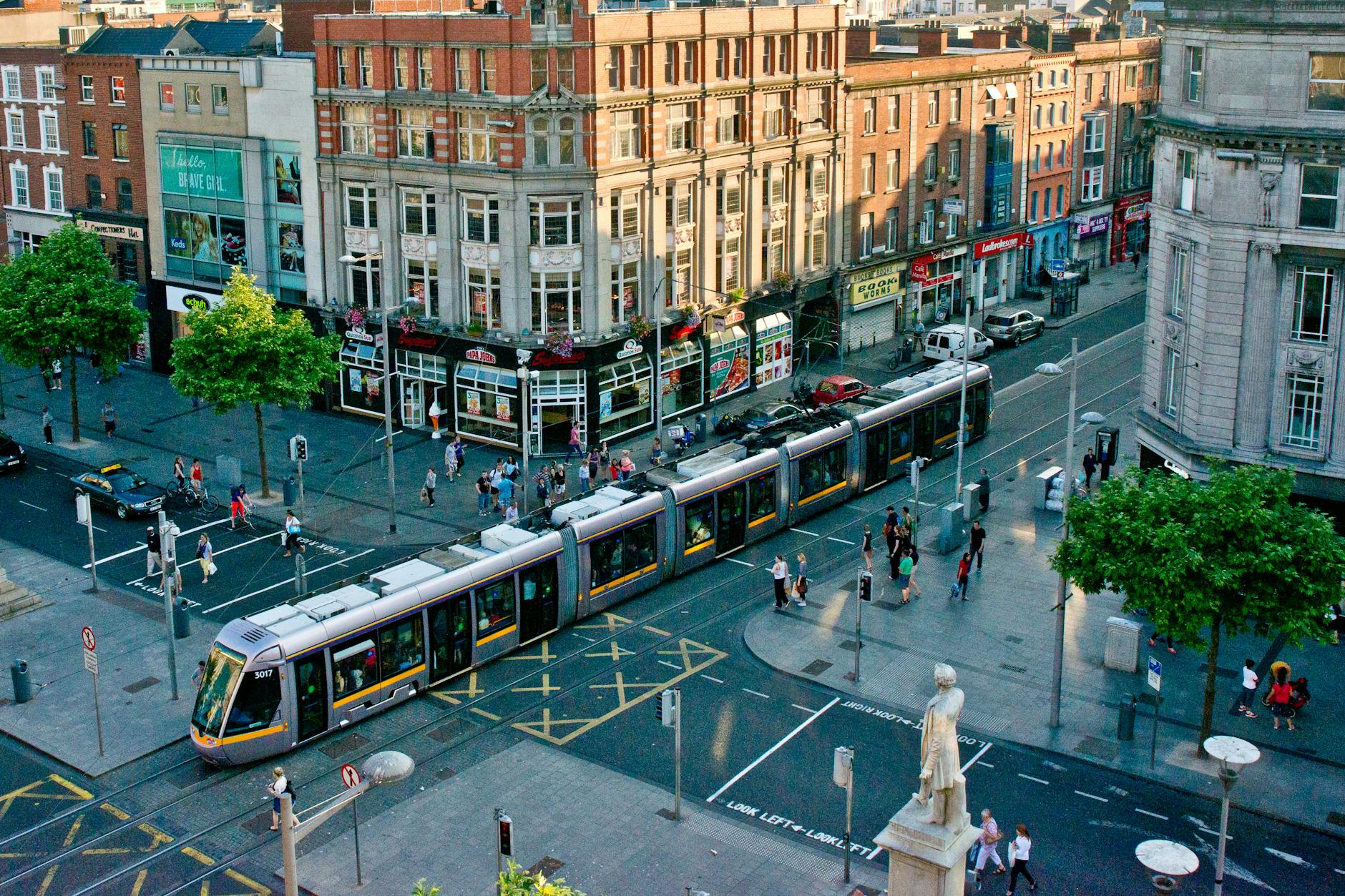
Luas (the Irish word for “speed”) is Dublin’s light-rail tram system, opened in 2004. Two lines, which have crossed in the city centre since the Cross City link opened in December 2017: change between them at Abbey Street (Red) and Marlborough Street or O’Connell – GPO (Green), a short walk apart. The Luas is the fastest way to move across central Dublin during the day.
Luas Green Line
Runs north-south from Broombridge (north of Phibsborough) through the city centre to Brides Glen (south Sandyford). 35 stops. The most-used tourist stops on the Green Line:
- Broombridge: Iarnrod Eireann interchange (Sligo/Maynooth trains)
- Cabra: For Phoenix Park north entrance
- Dominick: Hugh Lane Gallery, Garden of Remembrance
- O’Connell – GPO: O’Connell Street, GPO, Spire
- Marlborough: Abbey Theatre, Connolly Station
- Trinity: Trinity College, Bank of Ireland
- Dawson: Grafton Street south, Stephen’s Green
- St Stephen’s Green: Stephen’s Green Shopping Centre
- Charlemont: Portobello/Camden Street strip
- Ranelagh: Ranelagh village (restaurants, boutiques)
- Beechwood: Beechwood Avenue/Triangle area
- Cowper: Donnybrook
- Milltown: Royal Dublin Society, Aviva Stadium walking distance
- Windy Arbour: Royal Hospital Donnybrook
- Dundrum: Dundrum Town Centre shopping mall
- Sandyford: Business park, Beacon Hospital
- Brides Glen: End of line
Luas Red Line
Runs east-west from The Point (eastern docklands) through the city centre to Tallaght (south-west) and Saggart. 32 stops. Key tourist stops:
- The Point: 3 Arena venue beside the stop, North Wall
- Spencer Dock: Convention Centre Dublin, Bord Gais Energy Theatre
- Mayor Square: IFSC financial district
- George’s Dock: Famine Memorial
- Connolly: Connolly Station (DART, Belfast and northern intercity rail)
- Busaras: Bus Éireann main station
- Abbey Street: O’Connell Bridge area
- Jervis: Jervis Shopping Centre, Henry Street
- Four Courts: Four Courts, Smithfield walking distance
- Smithfield: Smithfield Square, Jameson Distillery
- Museum: National Museum of Ireland Decorative Arts & History (Collins Barracks)
- Heuston: Heuston Station (Cork, Galway, Limerick trains)
- James’s: Guinness Storehouse, St James’s Hospital
- Fatima: Pearse Lyons Distillery
- Suir Road: For Kilmainham Gaol (a short walk)
- Drimnagh: Royal Canal Park
- Bluebell: Bluebell industrial area
- Red Cow: Park-and-ride for M50
- Tallaght: Tallaght Shopping Centre, Tallaght Hospital
- Saggart: End of line
Luas Frequencies
- Peak hours (7-10am, 4-7pm Mon-Fri): The most frequent service of the day
- Off-peak weekdays: Every 7-10 minutes
- Saturdays: Every 8-12 minutes
- Sundays: Every 10-15 minutes
- First service: 5.30am (Mon-Fri), 6.30am (Sat), 7am (Sun)
- Last service: 12.30am (Mon-Sat), 11.30pm (Sun)

The DART (Dublin Area Rapid Transit)
The DART is the electrified suburban rail line running along Dublin Bay’s coast. Opened in 1984. Connects Howth and Malahide in the north through the city centre to Greystones in the south. The DART is Dublin’s most scenic transit ride — views of Dublin Bay, Sandycove’s Forty Foot, Killiney Bay “Dublin’s Bay of Naples.”
Northern DART (City to Howth/Malahide)
- Connolly: Main interchange with Luas Red Line, Belfast/northern intercity trains
- Tara Street: City centre south of Liffey
- Pearse: Trinity College, Westland Row
- Grand Canal Dock: Docklands, Aviva Stadium
- Lansdowne Road: Aviva Stadium (rugby/football)
- Sandymount: Sandymount Strand walking access
- Sydney Parade: Quiet residential area
- Booterstown: Booterstown Marsh nature reserve
- Blackrock: Blackrock village (Liath Michelin restaurant)
- Seapoint: Seapoint beach (cold-water swim)
- Salthill & Monkstown: Coastal residential
- Dun Laoghaire: Major port, James Joyce Tower, Forty Foot
- Sandycove: Sandycove beach, Forty Foot
- Glasthule: Sandycove village
- Dalkey: Dalkey village (Bono, Enya country)
- Killiney: Killiney Hill, Killiney Beach
- Shankill: Shankill village
- Bray: Bray promenade, Bray Head walks
- Greystones: End of southern line; coastal village
DART Frequencies
- Peak hours: Every 10 minutes
- Off-peak weekdays: About every 10 minutes, the same as peak
- Weekends: Less frequent than on weekdays
- First service: Early morning; the Irish Rail journey planner at irishrail.ie has exact times for your station
- Last service: Around midnight Mon-Sat (the last train leaves Howth at 23:55); check Sunday times before you set out

Paying for Luas and DART
Leap Card (Recommended)
For both Luas and DART, the Leap Card is the standard payment. Both systems use tap-on AND tap-off:
- Luas: Tap at the orange validator pillar at your boarding stop. Tap again at the orange validator at your destination stop. Both pillars are clearly marked.
- DART: Tap at the green/orange validator at the station entry (some stations have gates that won’t open without a valid tap). Tap again at the exit.
If you forget to tap off: The system charges a default maximum fare instead of the fare for your journey. If the charge looks wrong, contact Leap Card customer service.
Leap Visitor Card
The 1, 3 or 7-day Leap Visitor Cards (€8/€18/€24) include unlimited Luas and DART rides within the Short Hop Zone. Tap on/off the same way as standard Leap; no extra fare deducted.
Cash and Ticket Machines
Every Luas stop and DART station has a ticket machine. Single ticket prices:
- Luas single: €2.00 cash (one zone); with Leap, €1.50 Short Fare or €2.00 TFI 90 Minute Fare
- DART single (city zone): €1.50 Leap short fare
- DART Howth from city centre: €2.00 with Leap (TFI 90 Minute Fare)
- DART Bray from city centre: the same €2.00 Leap fare (TFI 90 Minute Fare)
Adult Leap fares are up to 30% cheaper than cash; always use Leap Card for Luas and DART.
Contactless Card
Contactless bank cards work at the Luas ticket machines, found at every stop, for purchases up to €50. What you get is a paper ticket at the cash fare: the platform validators take Leap cards, not bank cards, and you can’t buy a ticket on board. For anything more than a one-off ride, Leap is cheaper.

Best DART Day Trips for Tourists
Howth (northern end of the line)
The classic Dublin coastal day trip. DARTs from Connolly to Howth run about every 10 minutes. Howth offers cliff walks (the Bog of Frogs loop is about 12km, roughly 3 hours, starting from Howth station), seafood restaurants, a working harbour, and the Howth Market at weekends and on bank holidays. See our Howth Cliff Walk Guide.
Dun Laoghaire
Major port town with the East Pier promenade walk, the James Joyce Tower at Sandycove (the setting of the opening chapter of Ulysses), the Forty Foot cold-water swim spot, plus excellent fish-and-chips at Caviston’s Glasthule deli. Sunday brunch at Cinnamon Cafe is a Dublin tradition.
Sandycove & Forty Foot
The James Joyce Tower museum (free) is housed in a Martello tower where Joyce briefly lived. The Forty Foot below the tower is Dublin’s most famous open-water swimming spot — locals swim year-round including the Christmas Day plunge tradition.
Dalkey
Affluent coastal village; Dalkey Castle & Heritage Centre (15th-century tower house); Bono and Enya country (both live in nearby Killiney). Dalkey Hill walks; Vico Road views.
Killiney
Killiney Hill summit walk for the “Dublin’s Bay of Naples” view across Dublin Bay. Killiney Beach for swimming. Casual day-trip pair with Dalkey.
Bray
Beach town with Edwardian promenade. Bray Head walk (a climb to the summit). National SEA LIFE Bray Aquarium. Stay on the DART for Greystones, the next stop south.
Greystones (southern end of the line)
End of the DART line south. Quiet coastal village. The Cliff Walk from Bray to Greystones (about 7km, 2 hours) is closed until further notice after landslides, so skip the walk-one-way plan: climb Bray Head instead, then ride the DART on to Greystones for a stroll by the harbour and beach.
Best Luas Stops for Tourists
Trinity (Green Line)
Direct access to Trinity College and the Book of Kells. Walking access to Grafton Street and Dublin Castle.
St Stephen’s Green (Green Line)
The southern terminal of the Green Line until 2017 (now continues to Broombridge). Direct access to Stephen’s Green park, the Shelbourne, the National Concert Hall.
James’s (Red Line)
The stop for Guinness Storehouse. From the stop it’s a short walk east to the visitor entrance. Also Roe & Co Distillery walking distance.
Smithfield (Red Line)
Jameson Distillery Bow Street and the Cobblestone pub. Lighthouse Cinema. Generator Hostel.
Suir Road (Red Line)
Closest Luas stop to Kilmainham Gaol (a short walk south).
Heuston (Red Line)
Heuston Station for trains to Cork, Galway, Limerick, Waterford. Phoenix Park southern entrance.
Dundrum (Green Line)
Dundrum Town Centre — one of Ireland’s two largest shopping centres. Eight Luas stops south of Stephen’s Green.

How to Ride the Luas
- Find the orange Leap Card validator pillar at the platform.
- Tap your Leap Card on the validator. The reader beeps and shows your balance.
- Wait at the platform for your tram (real-time arrivals show on the digital screen).
- Board through any door. There’s no gate or driver to check tickets.
- Stand or sit; seats are first-come.
- The tram doesn’t announce stops as loudly as the bus — watch the platform signs and the digital strip inside the tram.
- Exit at your stop.
- Tap off at the orange validator pillar before you leave the platform.
How to Ride the DART
- Enter the DART station. Some stations (Connolly, Tara Street, Pearse) have entry/exit gates.
- Tap your Leap Card on the validator (or feed paper ticket through gate slot).
- Check the platform number for your destination — northbound and southbound use different platforms.
- Board any door when the train arrives.
- Most carriages have airline-style seating with luggage racks above. Carriages are not air-conditioned in older units.
- Audio and visual stop announcements are standard.
- Exit at your station.
- Tap off at the exit gate or validator. The gate opens if you have a valid tap.

Common Luas and DART Mistakes
- Not tapping off. The system charges maximum fare, so tap off at the end of every Luas and DART journey.
- Tapping on Luas at the wrong end of a station. Each platform has its own validator; tap on the platform you’re departing from.
- Boarding without tapping. On the Luas, inspectors issue a €100 Standard Fare Notice for fare evasion.
- Trying to use Leap on Aircoach. Aircoach is separate; doesn’t accept Leap.
- Riding the wrong direction on DART. Connolly Station has trains going north (Howth/Malahide) AND south (Bray/Greystones). Check platform signs.
- Missing the Luas line interchange. The Green Line and Red Line do not connect directly at any single stop. The closest connection is between Abbey Street (Red) and Marlborough/O’Connell (Green) — a 3-5 minute walk.
- Sitting in priority seats. The front of each tram/carriage has priority seats for elderly and mobility-impaired passengers. Give them up.
- Croke Park or Aviva Stadium match days. The Luas Red Line becomes severely overcrowded after Croke Park GAA matches; DART after Aviva Stadium rugby/football. Build extra time into journeys those days.
Combining Luas, DART and Dublin Bus
The three systems work together through the TFI 90 Minute Fare: with an adult Leap Card, one €2.00 fare covers eligible transfers made within 90 minutes of your first tap.
Example: 10am tap on Luas Green from Stephen’s Green to O’Connell – GPO (€2.00 TFI 90 Minute Fare). 11.30am tap on Dublin Bus 11 at Parnell Square to Phoenix Park — this is covered by the same fare. 12.30pm walk through Phoenix Park; 2.15pm Dublin Bus 11 back to the city centre — this is a new €2.00 fare because more than 90 minutes have passed.
The daily Leap cap (€6.00 adult) means heavy travel days combining bus, Luas and DART cost no more than €6.00 total. Once you hit the cap, further rides are free until it resets at 4.30am.
MetroLink: The Future of Dublin Rail
The MetroLink project will be Dublin’s first underground metro line, connecting Dublin Airport through the city centre to Sandyford. Planning approval came through when the Railway Order took effect in January 2026, and the project is now in procurement. Visible enabling works are due from late 2026, with heavy construction to follow final government approval, expected in late 2027 or early 2028. TII expects the line to be operational between 2036 and 2038.
Until then, the city-to-airport links are road-based: Dublin Express coaches (route 782 runs between the airport and Heuston via the Docklands and Trinity College), Aircoach, and Dublin Bus routes 16 and 41. The MetroLink will eventually deliver the direct rail-to-airport service Dublin has long lacked.
Accessibility on Luas and DART
- All Luas trams are wheelchair-accessible with low-floor entry and dedicated wheelchair space.
- Most DART stations have step-free access; older stations (Sandymount, Sydney Parade) may have only stairs.
- Ramps are deployed by station staff at gated stations for passengers needing assistance.
- Audio announcements on every tram and DART carriage.
- Visual displays show next stop and direction of travel.
- Wheelchair-accessible toilets on Connolly, Tara Street and Pearse stations.
Related Reading
For more transport guides, see Dublin Leap Card, Dublin Bus Guide for Tourists, Dublin Airport to City Centre, Dublin Taxi Guide, Walking in Dublin, and Howth Cliff Walk Day Trip.
Why DART is Dublin’s Most Scenic Transit Ride
For a single Leap fare, the DART delivers a scenic coastal ride along Dublin Bay. The southbound journey from Pearse Station hugs the coast from Sandymount onwards, passing Booterstown Marsh (a working tidal nature reserve with herons and oystercatchers), the elegant Edwardian terraces of Sandycove, the Forty Foot bathing place, the colourful boats of Dun Laoghaire harbour, and finally the cliff-edge run between Killiney and Bray with views across Killiney Bay — nicknamed Dublin’s “Bay of Naples” for its similar curve and southern exposure. Sit on the left (east) side of southbound trains to maximise sea views.
Northbound from Connolly, the scenery is more workaday until you pass through Killester and arrive at Howth Junction, where the line splits. The Howth branch then climbs the Howth peninsula, with sweeping bay views over the city skyline behind. Best photo opportunity: the train pulling into Howth Station with the harbour and Ireland’s Eye visible behind. On a clear day you can see the Mourne Mountains in Northern Ireland from the Howth platform.
When the Luas Beats the Bus (and Vice Versa)
The Luas is usually faster than parallel Dublin Bus routes during weekday rush hours. The Green Line from Stephen’s Green to Sandyford keeps moving when the roads clog, while Dublin Bus route 11, which covers similar ground, sits in the evening traffic. The Red Line from Connolly to James’s (for Guinness Storehouse) is the easy way across town. For any city-centre journey that lies within Luas reach, the tram wins on time, predictability and comfort.
Dublin Bus wins for everywhere the Luas doesn’t reach — which is most of the city. Route 11 serves Phoenix Park, and buses are the way into Rathmines, Donnybrook and most outlying day-trip points. Several places that look bus-only aren’t: Kilmainham Gaol is a short walk from the Suir Road stop on the Red Line, Ranelagh has its own Green Line stop, Stoneybatter is a walk from the Museum and Smithfield stops, and Drumcondra has a rail station. The combined Luas-Bus-DART network with a single Leap Card cap (€6.00 a day for adults) makes mixing modes a no-brainer.
DART, Luas and Match Days
Dublin’s two main stadium events affect public transport noticeably. Croke Park GAA matches and concerts draw huge crowds; the nearest Luas stop is Connolly (Red Line) plus a walk, and Dublin Bus routes near the stadium, including 1, 16, 19, 33, 41 and 44, run diversions after games and fill up fast, so allow extra time. Aviva Stadium (Lansdowne Road; rugby and football) sits directly on the DART line at Lansdowne Road station; the southbound DART after matches is standing-room-only and queues at the platform stretch up to the road.
If you’re sightseeing on a match day, plan around the post-game crowds: buses on the north side fill up after a Croke Park fixture, and DART trains along Dublin Bay are very busy once an Aviva match ends. Hotel concierges can confirm fixtures — the Sunday newspapers also list the day’s GAA card. Match days aren’t a reason to skip transit, but they reward a 30-minute time shift.
DART & Luas Dublin: FAQ
What is the difference between Luas and DART?
Luas is Dublin’s tram (light rail) system with two lines crossing the city centre. DART is the heavy-rail electric commuter line running along Dublin Bay’s coast from Howth to Greystones. Luas is faster across central Dublin; DART is faster for coast-bound day trips.
How much is a DART ticket?
With an adult Leap Card, a short city-zone hop costs €1.50, and longer trips such as Howth or Bray from the city centre come under the €2.00 TFI 90 Minute Fare. The adult daily Leap cap of €6.00 covers all your Dublin DART rides plus bus and Luas.
Which Luas line goes to Heuston Station?
The Luas Red Line. Heuston is 7 stops west of Connolly Station. Heuston Station serves Cork, Galway, Limerick and Waterford intercity trains.
Does the Luas connect to Dublin Airport?
No — neither the Luas nor the DART serves Dublin Airport. Take a Dublin Express coach (route 782 serves the city centre and Heuston), the Aircoach, or Dublin Bus routes 16 and 41. The proposed MetroLink underground metro will eventually connect the airport but isn’t expected until 2036-2038.
What is the Luas frequency?
Trams run most often in the weekday peaks (7-10am and 4-7pm); out at Tallaght they average every 6-8 minutes then and about every 9 minutes through the middle of the day, with more frequent trams in the city centre. First service 5.30am, last service 12.30am Mon-Sat (11.30pm Sundays). Real-time arrivals displayed at every stop.
How do I get to Howth from Dublin?
Take the DART from Connolly Station to Howth; trains run about every 10 minutes. Tap your Leap Card on the validator entering and exiting. Howth is one of Dublin’s best half-day trips for coastal walking and seafood lunches.
Can I use my Leap Card on DART and Luas?
Yes — both DART and Luas accept Leap Card. Tap on AND tap off at the orange validator pillars (Luas) or the entry/exit gates (DART). Standard adult Leap fares are up to 30% cheaper than cash; Leap Visitor Card includes unlimited rides.
Are Luas and DART wheelchair-accessible?
Yes — all Luas trams are low-floor wheelchair-accessible. Most DART stations have step-free access; older suburban stations may have stairs only. Station staff deploy ramps on request.
The southern DART line exists mostly for this: the Bray to Greystones coastal walk guide starts and ends at a station.
Keep Reading
- Best Beaches in Dublin — a station-by-station guide to every beach the DART reaches.
- Irish Rail for Tourists — where the DART ends and the intercity network begins.
- Day Trips from Dublin Without a Car — every escape the DART reaches inside your Leap Card zone, and where that zone ends.
- Dún Laoghaire, Dalkey and Killiney Hill — what to do with the southern branch of the line, station by station.
- Malahide Castle — the best reason to take the northern line, and the village that comes with it.
Lean na Comharthaí — Keep following the signs