Best Beaches in Dublin: Dollymount, Portmarnock, Killiney & the Forty Foot
Tránna Bhaile Átha Cliath
Ar an gComhartha Seo — On this sign
- Quick Answer: What Are the Best Beaches in Dublin?
- The Best Beaches Dublin Has, One by One
- The Forty Foot
- Water Quality: The Section Nobody Markets
- The Water Temperature, and When to Swim
- Getting There: The DART Does Almost All of It
- What Else to Do While You Are Out There
- Gotchas
- Best Beaches Dublin FAQ
- Keep Planning
- Keep Reading
- Photo Credits
Very few capital cities can put you on five kilometres of open sand twenty-five minutes after you leave the city centre, and fewer still can do it for the price of a bus fare. Dublin sits inside a wide, shallow bay with a train line running along both arms of it, and the result is a string of beaches that locals use constantly and visitors mostly never hear about. On the first warm Saturday of the year the DART to Portmarnock is standing room only, and on a grey Tuesday in November you can have a mile of Dollymount to yourself except for the dog walkers.
This guide covers the best beaches Dublin has, honestly ranked: which ones are actually good for swimming and which are really walking beaches, which held Blue Flags in 2026 and which did not, exactly how to reach each one on public transport, what the sea temperature really is, and the water-quality question that nobody markets but everybody local checks. It also covers the Forty Foot, which is not a beach at all and is the most famous place to get into the water in Ireland.
Quick Answer: What Are the Best Beaches in Dublin?
Portmarnock’s Velvet Strand is the best all-rounder — a long stretch of clean sand, a Blue Flag in 2026, and a DART station about 1.5 miles off (a 30–45 minute walk, so take the 32B or 42 bus to the beach). Killiney is the most beautiful, a shingle beach under wooded hills with the Sugar Loaf across the water, and the DART stops effectively on it. Dollymount Strand is one of the longest, about five kilometres of sand on the Bull Island nature reserve. Seapoint is the local swimmers’ choice, small, sheltered and Blue Flag. And the Forty Foot at Sandycove is not a beach but a rocky bathing place, free, open all year, and the most Dublin thing on this list.
The honest framing is that the best beaches Dublin has divide into swimming beaches and walking beaches, and the marketing rarely distinguishes. Sandymount Strand, for instance, is a magnificent walk and a poor swim — the tide goes out the best part of a kilometre and comes back faster than people expect. Knowing which is which is most of what this guide is for.
| Beach | Best for | Getting there | 2026 Blue Flag |
|---|---|---|---|
| Velvet Strand, Portmarnock | Swimming, long walks, families | DART to Portmarnock | Yes |
| Killiney | Views, a shingle swim, drama | DART to Killiney | Yes |
| Seapoint | Year-round swimmers, quick dips | DART to Seapoint | Yes |
| Balcarrick, Donabate | Space, dunes, quiet | DART to Donabate | Yes |
| Dollymount Strand | Huge sand, kite surfing, birds | Bus 130, or Clontarf Road DART and a walk | No |
| Burrow Beach, Sutton | Sheltered swimming, Howth views | DART to Sutton | No |
| Sandymount Strand | Walking and Joyce, not swimming | DART to Sandymount | No |
| The Forty Foot, Sandycove | Cold-water swimming, all year | DART to Sandycove & Glasthule | Not a beach |
The Best Beaches Dublin Has, One by One
Velvet Strand, Portmarnock
The one to pick if you are picking one. A long stretch of clean, pale, firm sand running north from Portmarnock village, backed by low dunes, with Ireland’s Eye and Howth Head filling the southern view. It held a Blue Flag in 2026 and the latest water-quality results are on beaches.ie.
The sand is firm enough to walk fast on, which sounds like a small thing and is not — a lot of Irish beaches are soft going. It is wide enough that even a busy summer Sunday does not feel crowded, and there is a decent run of cafés and chippers back in the village. Getting there is easy: take the 32B or 42 bus from the city centre, which both stop at the beach (check the day’s timetable on Dublin Bus’s site). The DART to Portmarnock works too, but the station is about 1.5 miles from the sand, a 30–45 minute walk.
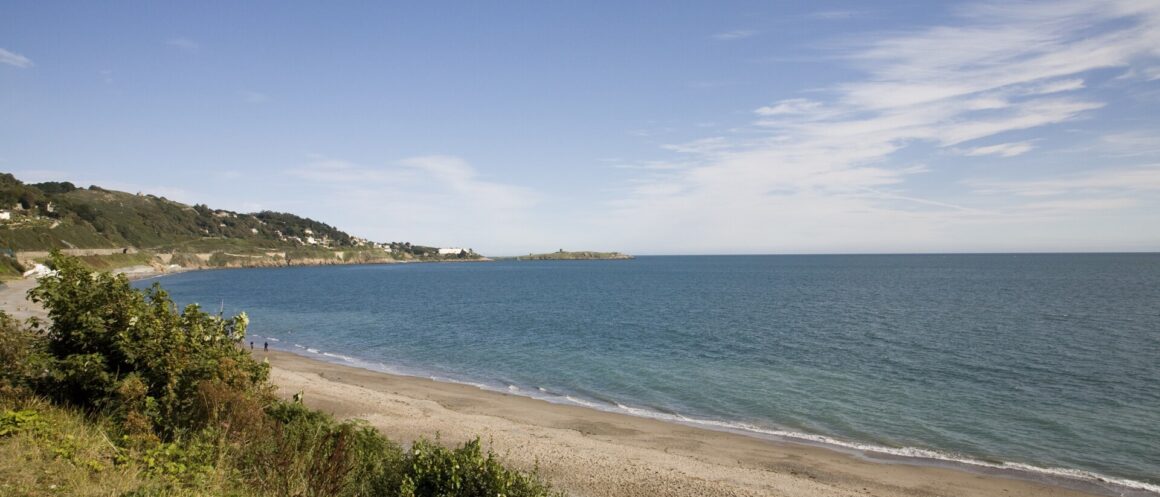
Killiney Beach
The most photogenic beach in County Dublin and the reason people compare the coast here to the Bay of Naples — a comparison that lives on in road names such as Vico Road. It is shingle rather than sand, which matters: it is hard on bare feet and it shelves steeply, but it means the water is clear and it drains fast after rain.
Blue Flag in 2026. The DART stops at Killiney station, which is essentially on the beach — one of the great arrivals in Irish public transport. Behind it, Killiney Hill gives you the view down over the whole bay to Bray Head and the Sugar Loaf; it is a proper climb, so treat it as a separate outing. Our coastal DART guide covers the whole stretch.
Seapoint
Small, sheltered, tucked below the coast road between Blackrock and Dún Laoghaire, with a Martello tower on the rocks above it. Blue Flag in 2026. This is not a beach you spend a day on — it is a beach you swim at, and it is where a great many Dubliners get into the sea year-round, at seven in the morning, in February, in a dryrobe, cheerfully.
Seapoint DART station is two minutes away. If you want the local sea-swimming experience without the Forty Foot’s crowds and Instagram queue, come here instead.
Dollymount Strand
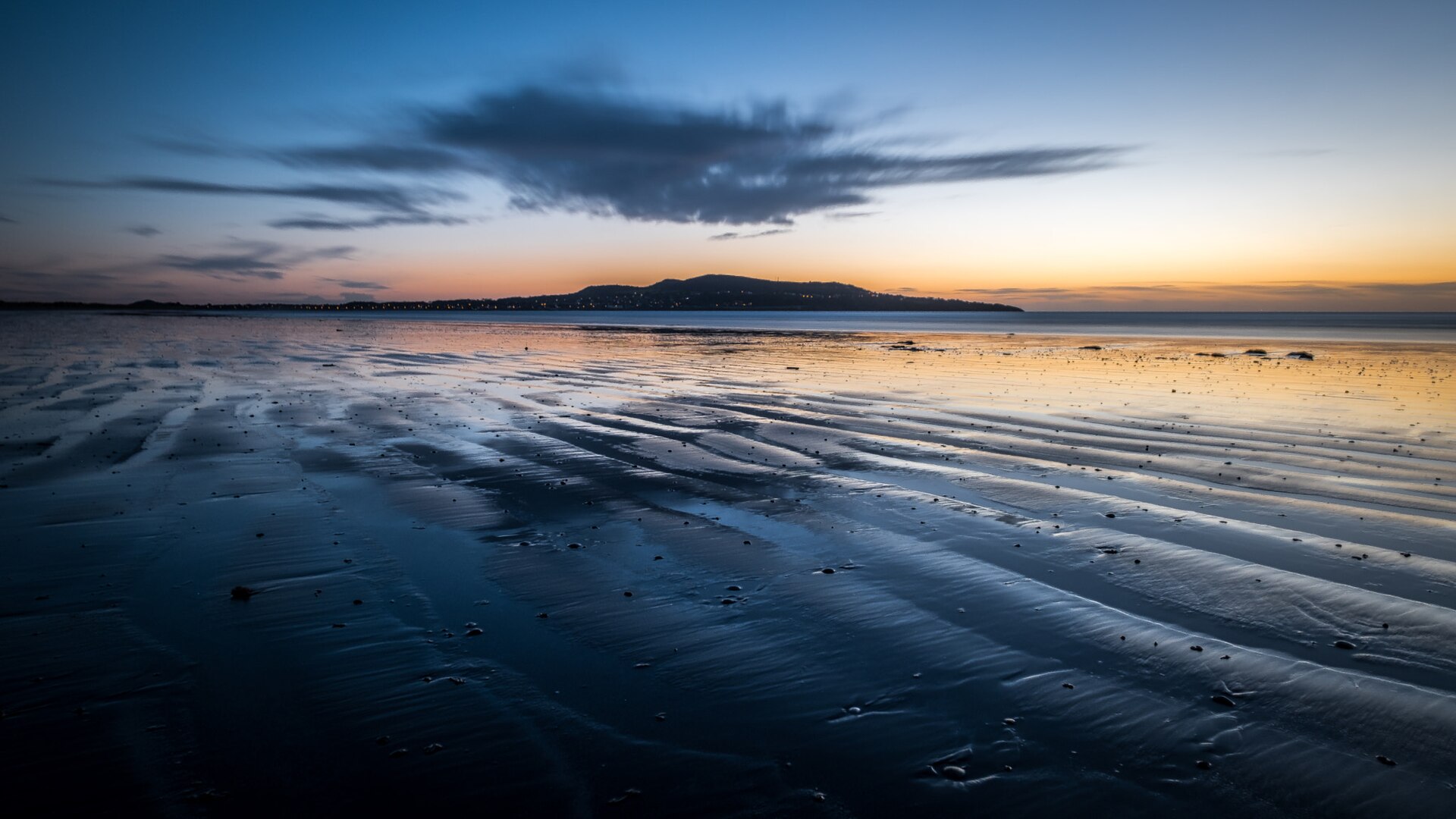
The big one, and the closest to the city — five kilometres of sand on North Bull Island, which is itself an accident of engineering. The island formed over the nineteenth century as sand accumulated behind the Bull Wall, built to stop the port silting up. It is now a UNESCO Biosphere Reserve and a bird sanctuary, with brent geese wintering in numbers you will hear before you see.
You reach it over a wooden bridge from Clontarf or via the causeway at the northern end. The 130 bus from the city centre is the simplest route; Clontarf Road DART leaves you with a walk still to go; the TFI journey planner shows the day’s options. Cars are permitted onto the sand at the causeway end, which visitors find bizarre and which is a long-standing local right.
The caveat, and it is a real one: Dollymount did not hold a Blue Flag in 2026, so treat the water with care. The usual trouble in this part of the bay is heavy rain, combined sewer overflow and a notice on the council website. Check before you swim. Walk, fly a kite, watch the kitesurfers, look at the birds: all excellent. Swim only after checking.
Sandymount Strand
The most literary beach in Ireland and the one you should not swim at. This is where Stephen Dedalus walks in the Proteus episode of Ulysses — “ineluctable modality of the visible” — and where the Nausicaa episode is set. It is a vast tidal flat: at low water the sea retreats close to a kilometre and the sand goes on in every direction under an enormous sky, with the Poolbeg chimneys to the north and the Wicklow hills to the south.
It is one of the best walks in Dublin and one of the worst swims. The water is shallow for a very long way, it warms and stagnates in the shallows, and — the serious point — the incoming tide moves faster than people expect across flat sand, and walkers do get cut off. Check the tide before you walk out, and turn back well before you think you need to. Fifteen minutes on the DART from the city centre to Sandymount station.
Burrow Beach, Sutton
Known locally as the Hole in the Wall, on the neck of land that joins Howth to the mainland. Sandy, sheltered, shallow, with Ireland’s Eye and Howth Head as a backdrop and views back across the bay to the city. No Blue Flag, but a genuine local favourite and one of the calmer places to bring children. Sutton DART station, then about ten minutes’ walk. Combine it with a trip to Howth village for lunch.
Balcarrick, Donabate
The furthest north of the beaches worth the trip, and the emptiest. Blue Flag in 2026, big dunes, a long sweep of sand, and enough space that it never feels busy. Donabate DART, about thirty-five minutes from Connolly, then a walk or a short taxi. Come here when Portmarnock is full.
Malahide and Low Rock
Malahide has a small strand and the more interesting Low Rock swimming spot just to the south, and the village itself is one of the most pleasant on the north Dublin coast. It works best as a half-day combined with Malahide Castle and its gardens. Malahide DART.

The Forty Foot
Not a beach. A rocky promontory at Sandycove with steps and ladders down into deep water, and the single most famous place to get into the sea in Ireland.
It is free. There is no ticket office, no turnstile, no season and no closing time — people swim here at dawn on Christmas morning and at nine on a Tuesday night in July. Access is by steps and ladders rather than a shelving beach, so it is deep immediately, which is exactly why cold-water swimmers like it and exactly why it does not suit small children or weak swimmers.
The history is part of the appeal. It was the Forty Foot Gentlemen’s Bathing Place, men-only and largely nude, until women’s groups forced the issue in the 1970s; it has been open to everybody since. Above it stands the Martello tower where Ulysses opens — “stately, plump Buck Mulligan” — now the James Joyce Tower and Museum, free to enter with walk-ins welcome, open Tuesday to Sunday 10:00–16:00 and closed on Mondays and around Christmas and New Year. Our James Joyce guide covers the wider trail.
Getting there: DART to Sandycove & Glasthule, then a walk of about ten to fifteen minutes — roughly a kilometre — along the seafront. There is limited parking and it fills early on any warm day; take the train.
What to expect: a small changing area, no lockers, no lifeguard, cold water and a great deal of company. Bring a towel you do not mind losing sand into, footwear for the rocks, and something warm for afterwards. The regulars are welcoming and will tell you where to get in.
Water Quality: The Section Nobody Markets
This is the part that separates a useful guide from a pretty one, and it is the thing every local checks before swimming at any of the best beaches Dublin has.
The Irish bathing season runs 1 June to 15 September. During it, Dublin City Council samples its bathing waters on at least twenty occasions, and fortnightly outside the season; Fingal and Dún Laoghaire–Rathdown publish their own results for their stretches of coast. Those results are public, they are updated through the season, and they are the source you should use rather than a blog.
The recurring issue in Dublin Bay is stormwater and combined sewer overflows after heavy rain. When the drainage system is overwhelmed, untreated water reaches the bay, and councils issue temporary prohibition notices until samples come back clean. It is not a permanent condition and it is not everywhere, but it is a real and recurring pattern.
The practical rule that Dublin swimmers actually follow: stay out of the inner bay after heavy rain, and check the council’s bathing-water page for the specific beach on the day. The outer beaches — Portmarnock, Donabate, Killiney — are much less affected than the inner-bay ones.
| Beach | Council area | Blue Flag 2026 |
|---|---|---|
| Velvet Strand, Portmarnock | Fingal | Yes |
| Balcarrick, Donabate | Fingal | Yes |
| Killiney | Dún Laoghaire–Rathdown | Yes |
| Seapoint | Dún Laoghaire–Rathdown | Yes |
| Dollymount Strand | Dublin City | No |

The Water Temperature, and When to Swim
Nobody tells visitors this plainly, so here it is, and it applies equally to every one of the best beaches Dublin can offer. Dublin’s sea peaks at about 15.5 °C in August and September, and bottoms out at about 7.5 °C in March. Even at its warmest it is cold by Mediterranean standards, and at its coldest it is genuinely a cold-water swim requiring some care.
| Month | Sea °C | Verdict |
|---|---|---|
| January | 9 | Regulars only, short dips |
| March | 7.5 | The coldest of the year |
| May | 10.5 | Bracing; wetsuit for anything long |
| July | 15 | Comfortable for a proper swim |
| August | 15.5 | The best month in the water |
| September | 15.5 | Equal best, and far quieter on the sand |
| October | 14 | Warmer than most people guess |
| December | 10.5 | Christmas Day swim territory |
The counter-intuitive point in that table is September. The sea is at its annual maximum, the air is still reasonable, the schools are back and the beaches are empty. It is the single best month for a swim in Dublin and almost nobody plans for it. Our best time to visit guide and weather guide have the month-by-month picture.
Getting There: The DART Does Almost All of It
The great advantage Dublin has over most coastal cities is that the railway runs along the shoreline in both directions, so the best beaches Dublin has are almost all a train ride away. Most of the beaches on this page are a DART station and a short walk away; Portmarnock and Dollymount are easier by bus.
| Beach | Station or route | Rough time from the centre |
|---|---|---|
| Sandymount Strand | Sandymount DART | DART, then a short walk |
| Seapoint | Seapoint DART | Beach at the station |
| The Forty Foot | Sandycove & Glasthule DART | 25 minutes plus a 10–15 minute walk |
| Killiney | Killiney DART | Beach at the station |
| Dollymount Strand | Bus 130 from the city centre | Check the TFI journey planner |
| Burrow Beach, Sutton | Sutton DART | DART, then a short walk |
| Velvet Strand, Portmarnock | Bus 32B or 42, or Portmarnock DART | Buses stop at the beach; the DART station is a 30–45 minute walk away |
| Balcarrick, Donabate | Donabate DART | DART, then a walk or taxi |
All of it is covered by a Leap Card, which caps your daily spend and is far cheaper than paying cash. The DART guide explains the line and the frequencies, and the transport guide covers the network. Weekend DART services to the coast get very full on hot days — travel before eleven or after four.
What Else to Do While You Are Out There
None of the best beaches Dublin has is a full day on its own unless the weather is exceptional, and the coast rewards combining them with something else.
- Howth — the harbour, the seals that beg at the fish shops, the cliff walk if you have the legs, and some of the best seafood in the county. Pair with Burrow Beach.
- Dún Laoghaire — the two Victorian piers are the finest level walk in Dublin, and there is an ice cream at the end of the East Pier that is a local institution. Pair with Seapoint or the Forty Foot.
- Dalkey and Killiney Hill — the village, the castle and the climb for the view over the bay. Pair with Killiney beach.
- Malahide Castle — the demesne and the walled garden, and a good village for lunch. Pair with Malahide strand.
- Bull Island — the interpretive centre, the birdlife and the kitesurfers. Pair with Dollymount, and bring binoculars in winter.
- Fish and chips — the correct meal after any of this. Our fish and chips guide names the ones worth the queue.
For a longer coastal outing, the Bray to Greystones cliff walk is the classic, and our day trips guide covers everything further afield.
Gotchas
The things that catch visitors out at the best beaches Dublin has are almost all avoidable with one check before you leave the hotel.
- Check the council bathing-water page before you swim, especially in the inner bay and after heavy rain.
- Lifeguards are seasonal and partial. Cover runs through the summer at the main beaches only, and not all day. Outside that, you are swimming unsupervised.
- Sandymount Strand cuts people off. The tide crosses flat sand faster than you expect. Check tide times and turn back early.
- Killiney is shingle, not sand. Beautiful, steep-shelving, and hard on bare feet — bring something to swim in on your feet.
- The Forty Foot has no lifeguard and deep water immediately. It is not a beach and it is not for children or nervous swimmers.
- Dollymount lets cars onto the sand. Watch children accordingly; it surprises every visitor.
- The DART fills up on hot days. Travel early or late, and expect to stand on a summer Saturday afternoon.
- The sea averages about 15.5 °C at its warmest. Plan for cold water even in August.
- Facilities are thin. Toilets, showers and changing places are limited or absent at most of these beaches. Portmarnock and Dún Laoghaire are the best served.
- Bull Island is a bird sanctuary. Dogs on leads, stay off the marsh, and give the wintering flocks room.

Best Beaches Dublin FAQ
What is the closest beach to Dublin city centre?
Sandymount Strand is the nearest, a short DART ride from the centre, though it is far better as a walk than a swim because the tide retreats close to a kilometre. Dollymount Strand on Bull Island is a bus ride away on the 130 and gives you about five kilometres of open sand. For an actual swim close to town, Seapoint is a short DART ride away and the station is beside the water — the most convenient of the best beaches Dublin has for a quick dip.
Are Dublin beaches safe for swimming?
Generally yes, with two caveats worth taking seriously. First, water quality in the inner bay can be affected by stormwater and sewer overflows after heavy rain, and councils can issue temporary prohibition notices when it happens. Check the relevant council’s bathing-water page on the day. Second, lifeguard cover is seasonal and partial, so outside summer at the main beaches you are swimming unsupervised. The outer beaches at Portmarnock, Donabate and Killiney are less affected by water-quality issues.
Is the Forty Foot free?
Yes, entirely. There is no ticket office, no turnstile and no admission charge, and it is open all year round with no closing time — people swim there on Christmas morning and at dusk in July. Access is by steps and ladders straight into deep water rather than a shelving beach, there is no lifeguard, and facilities amount to a small changing area. Take the DART to Sandycove & Glasthule and walk about a kilometre along the seafront.
Which Dublin beaches have Blue Flags?
In 2026 the Blue Flag beaches in County Dublin were Velvet Strand at Portmarnock and Balcarrick at Donabate in the Fingal area, and Killiney and Seapoint in Dún Laoghaire–Rathdown. Dollymount Strand did not hold one. The Blue Flag covers water quality, safety provision, environmental management and facilities, so it is a useful shorthand, but it is awarded annually and worth re-checking for the year you are travelling.
How cold is the sea in Dublin?
Colder than most visitors expect and warmer than most fear. The sea peaks at about 15.5 °C in August and September and falls to about 7.5 °C in March. July and August are comfortable for a proper swim without a wetsuit if you are used to northern water; May at 10.5 °C is bracing. September is the sweet spot — the sea is at its annual maximum and the beaches have emptied out.
Can you get to Dublin’s beaches by public transport?
Almost all of them, and easily — this is the real advantage Dublin has. The DART runs along the coast in both directions, and Sandymount, Seapoint, Killiney and Sutton have stations within walking distance of their beaches, with Killiney and Seapoint essentially at the sand. Malahide and Donabate are on the line too, though Donabate’s beach is a walk from its station. Portmarnock is easier on the 32B or 42 bus and Dollymount on the 130 from the city centre. A Leap Card covers everything and caps your daily spend.
Which is the best beach in Dublin for families?
Velvet Strand at Portmarnock is a good option for families, thanks to the combination of firm sand, space, a Blue Flag and a village with cafés and chippers behind it. Burrow Beach at Sutton is the calmer alternative — sheltered, shallow and smaller, with Howth Head as a backdrop. Avoid Killiney with small children because of the steep shingle, and be aware that cars are permitted onto the sand at Dollymount, which catches families out.
Can you surf or kitesurf in Dublin?
Kitesurfing yes, and Dollymount Strand is the main spot — the combination of wind across a wide flat beach makes it the centre of the scene in Dublin Bay, and watching it is worth the trip on a blustery day even if you are not going in. Conventional surfing is limited in the bay itself; the reliable swell is further down the east coast or, properly, on the west. Portmarnock and Donabate pick up more wind than the inner-bay beaches.
Keep Planning
The coast is the underrated half of a Dublin trip — these guides cover what sits around the best beaches Dublin can offer.
- Things to Do in Dublin — the full list, with the coast in context.
- Howth Village — harbour, seals, seafood and the cliff path.
- Dún Laoghaire, Dalkey and Killiney — the southern coastal DART day.
- DART and Luas Guide — the line that makes all of this work.
- Dublin Summer Events — what else is on when the beaches are worth it.
- Free Things to Do in Dublin — every beach on this page is free.
- Walking in Dublin — the coastal routes worth the trip.
- Best Fish and Chips in Dublin — the correct meal afterwards.
- Day Trips with Kids — beaches and everything else that works with children.
- Best Time to Visit Dublin — and why September beats July for a swim.
Keep Reading
Photo Credits
Killiney Beach: KILLINEY (Ireland) (1424715464) by William Murphy, CC BY-SA 2.0, via Wikimedia Commons.
Dollymount Strand at dawn: Bull Island At Sunrise Dublin Ireland Landscape Photography (197048387) by Giuseppe Milo, CC BY 3.0, via Wikimedia Commons.
DART at Portmarnock: Portmarnock Train Station by DubhEire, CC0, via Wikimedia Commons.
Lean na Comharthaí — Keep following the signs